Advertising in a Recession – Part 1 of CEO Preparedness Guide

Advertising in a Recession

Now Hear This!

Maintaining advertising in a recession has been proven over time to increase market share and boost revenues over time.

In these uncertain times amidst the COVID-19 pandemic, there are likely two distinct pathways for businesses to follow — adapt or perish. Because none of you reading this would ever consider laying down your arms and not fighting for survival, I thought I’d share a couple of quotes from noteworthy types who chose the latter mindset, choosing to both adapt, and thrive, rather than survive.

“To improve is to change.  To be perfect is to change often.”  –Winston Churchill

“Skate to where the puck is going to be, not where it is.” – Wayne Gretsky

Of course, your survival instinct is just a starting point. What will it take to truly gird your organization for the post-pandemic economic recovery?

In this blog and the one to follow, I’d like to lay out some steps that might be worth taking. First, we’ll discuss why your advertising budget should be spared the ax. We’ll then discuss strategies to employ to prepare for an economic rebound.

Onward, ho!

Playing to Win the Ad Game

History is full of examples where businesses that maintained or increased advertising budgets during a recession were rewarded with more market share and higher sales and profits.

Examples cited by Brad Adgate in Forbes:

  1. During the Great Depression, Post cereals reduced its advertising budget while Kellogg doubled its ad spend. The result? A catchy slogan — “Snap, Crackle and Pop” – for its new Rice Krispies cereal, and a 30 percent increase in post-depression profits. Oh, and they’ve been the market leader ever since.
  2. During the 17-month recession in 1973 -75, Toyota maintained its ad spend and became the No. 1 import in 1976, surpassing Volkswagen.
  3. In the 1990-91 recession, Taco Bell and Pizza Hut took advantage of McDonald’s decision to reduce its advertising spend. Pizza Hut sales increased 61 percent and Taco Bell,s jumped by 40 percent, while McDonald’s decreased 28%.

More than 40 studies over 93 years for Advertising in a Recession

In 2009, Gerard J. Tellis and Kethan Tellis compiled and synthesized 40 historical empirical and non-empirical studies on the topic of advertising in a recession.  What they found was a healthy dose of evidence that advertising during a recession is a good thing. Several studies found clear evidence the reduced recessional ad spending led to lower post-recession sales; still, other studies found that the inverse – higher spend led to higher sales – was true. And, some studies actually found that market share can actually increase more for some companies during a recession than in stable times. The likely reason is a combination of lost share by competitors and the entry of new, more nimble firms into the post-depression marketplace.

Advertising Drives Word of Mouth

In another example, researchers looked at the lessons learned from the automotive and financial industries during the 2008-2009 depression. Brad Fey and David Shiffman concluded that:

  • Advertising plays a substantial role in driving positive word of mouth (WOM) for major brands.
  • Even during a major crisis, ad-driven WOM continues to be nearly as positive as during normal times.
  • Cutting back ad spend during a crisis diminished the impact of a valuable tool for offsetting negative news (though customer service, public relations, and social media also play a role).

From personal experience, I lived in the 2008-2010 recession. While a member of the executive team at Firehouse Subs, we used the downturn to reposition the brand and double our ad spend – actions that led to increased market share and exponential growth from 2010 to 2016, at a 20 percent year-over-year clip.

I want to share one final quote from Mark Ritson, who made the following observation in Marketing Week just a few weeks ago:

“The optimum response to the recession is to maintain, and ideally increase your advertising investment.

Unfortunately, to pull this off you require three things. You need to have some money available to spend on advertising. Then you need an executive team smart enough to know marketing is an investment or trusting enough to listen to your presentation that explains all of this to them. And, finally, you need to not be shit.”

How Does This Relate to Today?

Of course, we know that cash flow is critical, and maintaining ad spend during this crisis is easier said than done for many brands.  But, if you have the ability to communicate with your customers through email/SMS text and other owned channels like social media, do it.  As Fey and Shiffman learned from their work, the message is important, and this is the time to do all you can to maintain positive Word of Mouth with your customers.

If you are fortunate to have cash reserves and can maintain ad spend, especially by shifting to digital channels where “shelter in place” directives have increased usage, do it too.

Messaging Counts Too

Now, the message you convey during the COVID-19 crisis will vary slightly by industry. In some industries like restaurants and retail that are considered essential services, the advertising message could be similar to pre-COVID-19 messaging, since customers seem to be sympathetic to the struggles being experienced by their local merchants.

But striking the right balance is critical. If you are seen as putting profits before people, you may squander trust in a way that it cannot be recovered. A recent study by Edelman on brand trust confirmed this fact but also found that most brands are using their advertising powers for good rather that evil. Consumers in the survey responded as follows:

  • 90 percent want brands to do everything they can to protect the well-being and financial security of their employees and suppliers, even if it means substantial financial losses until the pandemic ends.
  • 89 percent believe brands should offer free or lower-priced products to health workers, people at high risk, and those whose jobs have been affected.
  • 83 percent are seeking a compassionate connection, including brand messaging that communicates empathy and support with the struggles they face.
  • 84 percent are turning to brand social channels to find a sense of community and offer support to those in need.
  • 65 percent like hearing from brands they use about what they are doing in response to the pandemic because it is comforting and reassuring to them.

The takeaway?

Though it may be ok to advertise product or brand, as usual, it is advisable to change messaging, especially in owned channels like email, SMS/text, and social to a more humanistic tone and values.

“There is no doubt that the COVID-19 crisis is more than a recession.  It is much worse and physical distancing is a demand killer.  However, we at Edleman believe there will be much pent-up demand after the tide turns.  American consumers like to be mobile, to eat out and spend money shopping.  Don’t under-estimate the power of “Cabin Fever” and the “stir-craziness” for all Americans due to physical distancing.”

In our next blog, we’ll look at the importance of strategic go-to-market planning in being ready for the rebound.

Photo Doug Reifschneider
Doug Reifschneider


Thank you for visiting our blog.

Jim Weber – Managing Partner, ITB Partners

I hope you enjoyed our point of view and would like to receive regular posts directly to your email inbox.  Toward this end, put your contact information on my mailing list.

Your feedback helps me continue to publish articles that you want to read.  Your input is very important to me so; please leave a comment.

Jim Weber – Managing Partner, ITB Partners


Who can Keep Up with Marketing Technology?

According to a recent study by Chief Outsiders, a national marketing strategy consulting firm, 88% of Chief Marketing Officers (CMOs) see the difficulty in staying ahead of Marketing Technology.

Why?

According to Forrester, technology has not just impacted business, it has disrupted it. So much so that CNBC reported that the average life span of an S&P 500 company is about 20 years. It was 60 years in the 1950s according to Credit Suisse. 1

The way technology is evolving, imagine what that figure might be in 20 years.

All you have to do is look at Moore’s law to understand why technology is moving so fast.

What is Moore’s Law & How Does It Impact Marketing Technology?

In 1965, Gordon E. Moore, the co-founder of Intel, made this observation that became Moore’s Law.

Moore’s Law refers to Moore’s perception that the number of transistors on a microchip doubles every two years, though the cost of computers is halved. In addition, Moore’s Law states that we can expect the speed and capability of our computers to increase every couple of years.  Plus, we will pay less for them too. Another tenet of Moore’s Law asserts that this growth is exponential.2

Marketing Technology is influenced by Moore's Law
Moore’s Law tenet is that the number of computer chips on a single board grows exponentially.

Source: Moore’s Law graph3

It is hard for a human to keep up with exponential growth. And marketers are human.  This is why marketers are having trouble keeping up with marketing technology.

Why specifically do CMOs think it will be hard to stay ahead of technology?

Because many CMOs haven’t kept up with marketing technology to-date.  And the exponential growth that is expected to continue will be mind-boggling.

The Marketing Menu Changed!

For example, as recently as the 1990s, marketers had a finite list of advertising and promotional tactics at their disposal.  The tactics to increase sales, improve brand awareness, and grow market share were low tech too.

  • Television (local, spot and cable)
  • Radio (Local & national)
  • Print (Direct mail, FSI’s, newspaper -remember those?)
  • Out of Home (Billboards, transit benches, and shelters, taxi’s, etc.)
  • Promotion (sports teams, schools, etc.)
  • Yellow pages if a local or multi-location business

Today, with the addition of  OTT (Over the Top) TV, banner ads, advertising on social media, and other digital options, the choices on where to place advertising dollars are staggering.

MARTech = Marketing Technology

The modern CMO is faced with options in Martech and Adtech.  Yes, those are real terms used within the marketing world. In 2011, we had about 150 MarTech choices.  By 2019, there were over 7,000 choices.

Marketing Technology growth since 2011
In 2011, there were about 150+ Martech vendors. By 2019, there were over 7000!


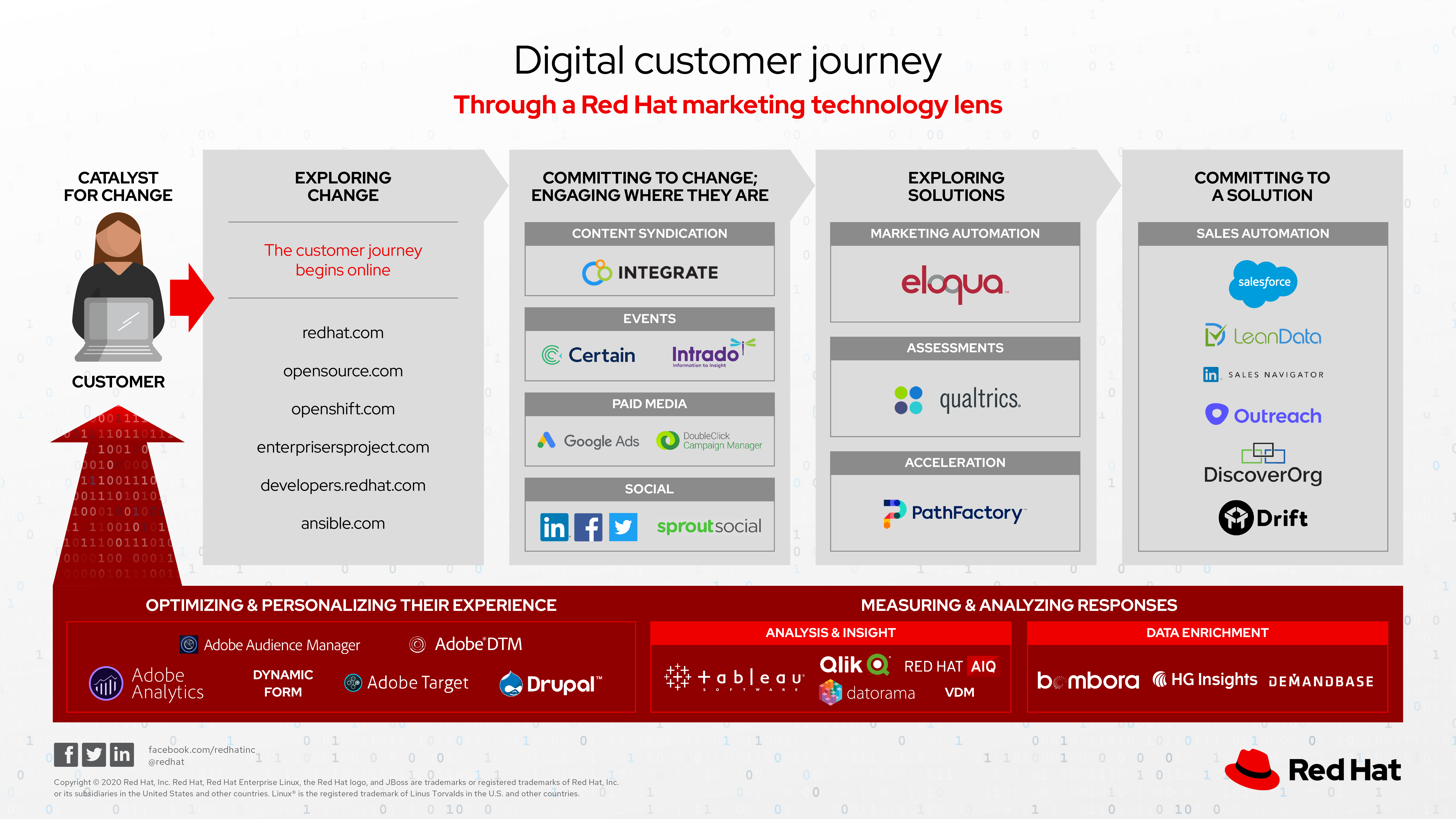
To put in perspective, RedHat published the following tech stack that is aligned with the customer journey. One brand using this technique would interact with over 30 Martech vendors.

Who can keep up with that, let alone stay ahead of it?

Marketing Technology used for customer journey
Illustrates 30 MarTech companies have to work with to manage the customer journey.

Source: 4

Technology has disrupted business in many ways.  According to Forrester, the primary reason technology has disrupted business is based on three issues:

  • Empowered consumers
  • Blurred lines between digital and physical
  • Disruptive business models powered by data and tech

In their reports titled “Winning In The Age Of The Customer,” and “The Customer-Obsessed Enterprise” Forrester suggests that companies that are not just customer-focused, but customer-obsessed, achieve higher revenue growth, customer satisfaction, and employee satisfaction.

Enter the COVID-19 pandemic

To put into perspective how important technology to business is, consider how different brands in food service were impacted by the pandemic.


As reported in QSR magazine for Domino’s “What’s happened in the first four weeks of Q2 (March 23 to April 19) has been more enlightening. Domino’s witnessed U.S. company comps jump 10.6 percent. Franchises are up 6.9 percent. Blended, it’s a 7.1 percent year-over-year same-store number.”

Chipotle’s digital sales grew 80.8% and accounted for 26.3% of sales for the quarter leading into the pandemic. Source:   https://ir.chipotle.com/2020-04-21-Chipotle-Announces-First-Quarter-2020-Results

The first 3 examples are from brands that were already focusing on their digital capabilities.  Wing Stop was one of the first restaurant brands to offer chatbot ordering on social media platforms. And Domino’s has become the de facto leader in the pizza segment when it comes to technology.

The key takeaway for restaurants is that the pandemic created a new set of consumer desires and demands and the brands (often chain with marketing teams) already knowledgeable and leading in technology won. This plays out in retail too.  If you’re a retailer and you didn’t have an eCommerce platform prior to March 13, you’re probably hurting bad, or closed.

The pandemic forced many brands to accelerate their use and adoption of technology to meet the new consumer needs.

Conclusion

The bottom line when it comes to brick & mortar businesses is that marketing technology is part of the customer experience and great technology can create a great frictionless user experience. Bad technology can do the opposite. The pandemic forced business owners to embrace eCommerce, digital ordering, and contactless payments and transactions faster than ever before. Consequently, brick & mortar brands must:

  1. Own all the consumer touchpoints
  2. Own customer data
  3. Connect offline to online for a true omnidirectional view of your customers

It’s not easy to keep up with technology. The effects of social distancing and working from home simply made every business pivot or adapt to less touch and more connection via technology.

If Forrester is right, the technology we marketers use to reach intended customers needs to pivot and more companies need to become customer-obsessed to succeed.

Staying ahead of that trend will be very difficult, very difficult indeed.


Head shot of Doug Reifschneider
Doug Reifschneider

Doug Reifschneider is a 30+ year marketing veteran in the foodservice industry.  He currently works with Chief Outsiders as a fractional CMO.

https://www.itbpartners.com/doug-reifschneider/

Sources:

  1. https://www.cnbc.com/2017/08/24/technology-killing-off-corporations-average-lifespan-of-company-under-20-years.html
  2. https://www.investopedia.com/terms/m/mooreslaw.asp#nearly-60-years-old-still-strong
  3. https://hackernoon.com/moores-law-is-alive-and-well-adc010ea7a63?source=rss——-1
  4. https://cdn.chiefmartec.com/wp-content/uploads/2020/02/red-hat-martech-stackie.jpg
  5. Source: Winning In The Age Of The Customer Forrester report
  6. Source: The Customer-Obsessed Enterprise Forrester report


The Laws of Growth

Growing up on a small farm in South Georgia, I learned at an early age there were laws that governed the growth of crops and animals. Now as an adult I hear everyone talking about growing a business, growing a family, growing a political party, growing a church – it seems like everybody is trying to grow something!! It has occurred to me that the Laws of Growth I learned on the farm about growing an organism might also apply to grow an organization.

The First Law of Growth is that Growth is the NATURAL RESULT of a healthy organism.  We did not go out every morning and wake the cows up and encourage them to grow! We kept them fed and watered and they just grew!  For those of you who have children, you never had to go in the baby’s room and tell Junior it was time to start stretching so he would grow! You just had to keep him fed and watered and he grew!

May I be so bold as to suggest that if we have a healthy organization, it too will naturally grow?  If we build an organization where people want to work and contribute, they will not want to leave and will become a brand ambassador for other people looking for a healthy work environment. And our clients and customers will benefit from their loyalty and will want to purchase as many of our products and services as they can use, and they too will become brand ambassadors for others needing what you provide!

So how do you go about creating that healthy organization?

The Second Law of Growth is you must Plant the Seeds to Reap a Harvest. You can’t just lay the seeds on top of the ground and expect to reap anything on the farm, and you can’t just talk about what you’re going to do, you must actually DO something!

You have to break up the fallow ground, plow it up, loosen the soil, allow it to breathe and accept rainwater! When is the last time you took a long, hard look at how you do what it is that you do? How long have you been doing the same old thing the same old way? Are there parts of your organization that needs the refreshing of a good plowing?

Now, this is not the “just change something to be changing” mantra, but would any of your key people benefit from some additional training or a motivational seminar?  Are there processes that could be changed to produce better outcomes? Would it help to have a consultant or outside advisor come in and give your organization a complete evaluation top to bottom? What would happen in your organization if you pulled your salespeople into work in operations and sent your operations people out to make sales calls – even for a short period of time?

It has been said that a RUT is just a grave with the ends knocked out and ruts can be deadly in an organization if not plowed up!

The Third Law is you REAP what you SOW! This could be a book in itself!  You will reap the ATTITUDE you sow! You will reap the employees you hire! You will reap the character you develop! You will reap the policies you implement!

On the farm, it didn’t cost much more to purchase the BEST seeds, and, in the long run, they always gave the best yield. Might I propose that hiring the best people will, in the long run, be your best bargain? Hiring less than the best is a false economy – you will always get what you pay for!

The Fourth Law is that your Harvest is directly proportional to the care you provide your crops. You have to make sure your plants are receiving adequate water and fertilizer, and your employees must be receiving adequate compensation and training!  Your clients and customers must be receiving high-touch relationships and quality products and services! Start being stingy and your organization will react.

The Fifth Law is you must PULL the WEEDS! If there is someone in your organization that is not contributing, either motivate them, train them or fire them.  If there is anyone sowing discord, fire them immediately. Crops cannot compete with weeds for water and fertilizer and your employees are not going to thrive with negativity in their world.  And dare I say sometimes a client or customer can become a weed.  Don’t be afraid to fire one of them if they are creating more problems than they are worth.

The Sixth Law is you will always reap MORE than you sow!  For every seed of corn you plant, you will reap 2 to 4 EARS of corn come the harvest!  There should be a positive ROI on every employee and every customer, and that ROI is going to be influenced by how well the leader leads. Unfortunately, this law also works in the negative – reaping more grief than was sown.

The Seventh Law is you reap LATER than you sow! There is no magic wand to instantly create a healthy organization.  It takes time for the efforts you put in to produce the results you are wanting, but don’t let that discourage you from starting the process. Consider it motivation to start NOW!  Get a sense of urgency about creating a great organization.

So, in closing, I recall the words of Kevin Costner in The Field of Dreams, you build a healthy organization and they will come! Employees will come! Clients and customers will come! Profits will come!

Ralph Watson

Ralph Watson has a varied and extensive career spanning 45 years of increasingly responsible positions in both sales and operations in a very diverse mix of industry specialties, including food processing, textile and apparel, financial services, and professional management consulting.

Ralph served as a Senior Executive Analyst with a number of international consulting companies focused on the family-owned, privately held market where he distinguished himself as one of the top analysts in a highly competitive field.  In early 2014, he personally coached 10 businesses in Europe.

Ralph C. Watson, Jr.   404-520-1030

Thank you for visiting our blog.

I hope you enjoyed our point of view and would like to receive regular posts directly to your email inbox.  Toward this end, put your contact information on my mailing list.

Your feedback helps me continue to publish articles that you want to read.  Your input is very important to me so; please leave a comment.

Jim Weber – Managing Partner, ITB Partners


The Isolation of Ownership

Bottomline First: Owners don’t really have anyone to talk to about their problems. Reach out to those in your care.

Outside of a preacher in a small church, I don’t know of a more lonely calling than a small business owner.

I will often ask them, “Do you know what your friends think of you?”

They look at me with stunned incredulity since I had only met them a couple of hours earlier and know none of their friends.

I proceed to tell them, “Your friends think they have it made, they think you come and go as you please, hire people to do what you don’t want to do and write it all off on your taxes!!  They think you have the Life of Riley!”

Then they say, “You know, you are absolutely right!”

And I assure them if they try to convince their friends just how hard it is owning a business, they think you are pulling their leg!

And THIS is during the GOOD times!  The loneliness is only getting worse in the economic environment of the day!

Many times business owners will become overly friendly with their employees to cope with their isolation knowing they get the day-to-day stresses with which the owner is dealing. But that becomes a management problem within the business and makes it almost unthinkable to furlough them when times get tough.

Business owners are seen as “having it all together” not only by their friends and the public at large but also by their families.  I can’t tell you how many times I have interviewed a business owner during an analytical survey of their company who was showing a loss on their P&L only to discover he (or she) had not told their spouse. And let’s be honest, men, we are more guilty of this than our sisters-in-business. That stinkin’ EGO of ours gets us in trouble and then cuts off the support we so desperately need!

So to you advisors of these stalwart but hurting heroes of our economy, reach out to them! They need to know there are people and places that can be safe for them to unmask their pain.

Bankers, attorneys, wealth advisors, CPAs, insurance agents, consultants, accounting firms, HR firms – any trusted advisor in their life can just BE THERE for them and let them know it is OK for them to share anything that is bothering them.

If you are in a role they might not feel comfortable due to the business relationship (like their banker), try suggesting they might want to talk to a friend of yours.

As Charles Dickens wrote in the Tale of Two Cities, “It was the best of times, it was the worst of time…”  We have been brutally snatched out of “the best of times” and forced into what is arguably “the worst of times.”

As a man of faith, I would that all men and women would seek guidance from the Creator of us all to lean into Him and His wisdom for our individual and corporate deliverance.

Let’s all be there for each other as we walk through the valley of shadows.

Ralph Watson

Ralph Watson has a varied and extensive career spanning 45 years of increasingly responsible positions in both sales and operations in a very diverse mix of industry specialties, including food processing, textile and apparel, financial services, and professional management consulting.


Ralph served as a Senior Executive Analyst with a number of international consulting companies focused on the family-owned, privately held market where he distinguished himself as one of the top analysts in a highly competitive field.  In early 2014, he personally coached 10 businesses in Europe.

Ralph C. Watson, Jr.    404.520.1030

Ralph.Watson@BeGreaterFaster.com

Are You Loyal to Your Customers?

Doug Reifschneider

We love our customers

Loyalty, not such a long time ago, was a fairly easy thing to cultivate. You give a punch card or green stamps (or even wooden “round-tuits,” some of you may recall) to your customers, and they reward you with frequent visits or purchases so they can earn the points or badges to pocket free stuff.

Even today, as businesses like restaurants, retail stores, airlines, and hotels work to digitize and mobilize loyalty programs, customers still find it exciting and compelling to rack up the rewards.

But a funny thing happened on the way to the bank—loyalty, it seems, can be a fairly fickle concept—and even with the ease of participating in today’s e-programs, they don’t seem to be creating the brand affinity and “stickiness” that companies crave.

In fact, a third of customers will vote with their feet after a single instance of poor customer service, according to one survey. Keep ‘em happy, however – with outstanding personal service, great products, and minimal gimmickry—and you have an 80 percent chance of cementing that loyalty.

The message here: Being loyal to your customers, in today’s uber-competitive landscape, is as critical—if not more so—as customers being loyal to you.

If it seems like the script has been flipped, you’re right. In the days of Loyalty 1.0, those green stamps paved a one-way street of loyalty, from consumer to company. But now, in the world of Loyalty 1.5, with the ability to gain insights through apps, clicks, interactions, and views, it’s easier than ever to open a reverse lane of loyalty traffic from the company, right back to the customer.

So, let’s step back for a moment and think about what we really want to do. How do we tool our loyalty programs to demonstrate our love of, and affinity for, our consuming public? And, in particular, how do we replicate this online, without the benefit of the human interaction that comes with bricks-and-mortar businesses?

How to be loyal to your guests

Here’s an example using a counter service fast-casual restaurant concept.

Imagine if you will, striding into a local fast-casual restaurant near your office.  You’ve been in about once per week for the last two months because it is close, and you like the food.  You decide you’re in the mood for their grub again for lunch, so you cross the street, walk in the door, and take your place in line.

As you wait, you look at the menu and think about the meeting you just departed. Now, you approach your cashier, Susan (you know because of her name tag) and she looks up and says, “Hi, Mr. Smith! Great to see you. Would you like the usual today?”  You are shocked she knows your name and are impressed she knows your usual order. You reply, “Yes, please,” and add a drink. Susan goes on to say, “Mr. Smith, you’ve been in a lot recently and we love serving you.  Lunch is on us today!”

In this scenario, it’s easy to see why you would be floored. Susan not only knew your name, but she comped your meal too. The rest of the experience is equally as stellar (clean restrooms, a spotless restaurant, a follow-up visit from the manager) and you return to the office and tell six of your co-workers. The restaurant was loyal to you — which created an emotional bond, and the intensification of your love for that restaurant brand.

Loyalty 1.0 and 1.5 promised the ability to scale loyalty, and in most cases it did. But to add personalized messaging – like that offered by the restaurant chain — and to attempt to be loyal to your guests on this type of grand scale, takes time and a mastery of technology. Is your company up to the challenge?

If you’ve been around for awhile, perhaps you felt a little déjà vu when you heard loyalty platforms would save your team time?

Many years ago in a galaxy far, far away, a similar promise was made…

The Machine of The Year – 1982

Promise to save time

At the dawn of personal computing, and before PCs and laptops became ubiquitous, we were promised that these gizmos were going to make our lives easier and give us more time to enjoy life.

The impact of the Apple II and the IBM PC was fully demonstrated when Time magazine named the home computer the “Person” of the Year for 1982. It was the first time in the history of the venerable publication that an inanimate object was bestowed with this award.

An excerpt from an accompanying article, “A New World of Dreams,” painted a rosy picture of a promised future:

“…Point is, it will save you time. Time time time. And we need all the time we can save. Can’t kill time without injuring eternity. Thoreau said that. Great American, Thoreau.

You say: Why should I want to save time? I hear you, friend. I hear you. You wonder where it gets you, saving all that time when you think about old Henry Ford’s gizmo that was supposed to save a peck of time. Only instead of conquering the open road, we wound up living on it. You’ve got a point. You a college boy? But this is the country of the A-bomb and the zipper. We always save time, good and bad. Tempus fugit. Time is money. Most of all, time is dreams. And computers give you time for dreams.”

Loyalty 2.0

So, how do we upgrade to Loyalty 2.0? How do we blend all that we have learned to produce a loyalty relationship with our clients that is as strong as the one we wish them to have with us? A good starting point is to replicate the 1-to-1 experience – with as much richness as we can – in the digital universe.

For a Loyalty 2.0 program to succeed, it needs to have a few of the following features:

  • Social media integration
  • Detailed analytics
  • Targeted email marketing
  • Targeted text message marketing
  • Smartphone integration and an app
  • Software that’s integrated with POS
  • Segmentation tools
  • Campaign tools
  • Customer recognition
  • Loyalty automation

The last four points are the most important. Most Loyalty 1.5 platforms lacked automated campaign and segmentation tools. Or, took too much time and effort from your teams to create the kind of personal connections we are advocating for now.

To get your company on track quickly, you might consider a provider like Punchh, LevelUp, Paytronix, and others that live in the Loyalty 2.0 space.

All of these are vendors that are purely focused on the B2C experience. They are dedicated to providing clients with a mobile-first strategy. It makes it easy to analyze customer behavior, generate insights, and develop sophisticated marketing automation. And it makes customized campaigns and promotions possible. Most offer deep integrations with leading eCommerce/online ordering, POS, and payment providers. All that provides marketers with a single view of the customer for omnichannel engagement across physical retail and digital channels.

Are you ready to take a leap forward into the world of two-way loyalty? By adopting a Loyalty 2.0 mindset, you will find it easier to be loyal to your customers. However, you’ll still need to commit corporate resources to execute with success if your customers are to feel the love.


Doug Reifschneider
Doug Reifschneider

Doug Reifschneider is a dynamic results-oriented, data-driven professional, Douglas drives nationwide growth through the creation and delivery of unique, creative brand strategies enhancing customer affinity and market position. With 25+ years of executive marketing experience, he strengthens brand equity with resonating positioning strategies. He uses successful marketing programs and innovative marketing campaigns that boost revenues. An innovative leader with strong team-building and collaboration skills, his strategic initiatives generate substantial shareholder and franchisee value and open new revenue opportunities.

Thank you for visiting our blog.

I hope you enjoyed our point of view and would like to receive regular posts directly to your email inbox.  Toward this end, put your contact information on my mailing list.

Your feedback helps me continue to publish articles that you want to read.  Your input is very important to me so; please leave a comment.

Jim Weber – Managing Partner, ITB Partners

Business & The Virus

A prudent man foreseeth the evil, and hideth himself (or ‘seeks refuge’): but the simple pass on, and are punished.  Proverbs 22:3

Ralph Watson

Regardless of where Covid-19 originated, it is an actual virus and it is among us.

Mass hysteria has gripped our country emptying our grocery stores and gun shops and tanking our economy. I’m not making a political statement nor placing blame.  I am simply acknowledging the current reality of our world and the tragic effect it is having on our businesses, large and small.

Let me invite you to step away from the madness for a few minutes for a dispassionate chat about our current situation.

At this point, there is precious little we can do with the country on lockdown.  Our customers are not circulating in the marketplace, but are rather cocooned in their homes possibly shopping online. That doesn’t mean we can’t do ANYthing!

In his seminal book, The 7 Habits of Highly Effective People, Stephen Covey presented his Time Management Matrix exposing the relationship between Urgent tasks and Important tasks.

Quadrant I was the “Urgent & Important” containing all the fires that business owners face all day long: operational breakdowns, customer complaints, employee disagreements, accounts receivables, job bidding, and the list goes on ad infinitum! This is the quadrant in which we spend most of our waking business hours.

Quadrant II was the “Important but NOT Urgent” containing – honestly – all the most important issues of life: date night with the spouse, children’s ball game or dance recital, thinking & planning, reading important literature, praying or meditating, taking care of our health and on it goes.

The paradox of these two quadrants is that the ONLY way to get Quadrant I under control is to camp out in Quadrant II and DO the Important work of strategic business planning and management self-improvement! As you are able to become proactive and look down the road to see potential dangers, you are able to make those provisions to avoid the fires and reduce the size and tyranny of Quadrant I.

Although this may be the first time our current living generation has seen what is happening, it is not the first time for our country.  Let me acknowledge that during the Great Depression, there were bakeries that went out of business – but there were bakeries that survived. There were clothing stores that went out of business, but there were clothing stores that made it.

The point is that no business segment vanished. Some businesses in every category made it in spite of so many of their competitors folding for good.  So while we are all currently forced out of Quadrant I, now is a great time to take full advantage of the situation to get seriously deep into Quadrant II and not squander this unique opportunity to Be Greater Faster!

Read a management book. Call friends who own businesses to talk about common issues. Engage with a professional consultant – a generalist if you need overall help, or a specialist if you feel you need specific help like marketing. Reconnect with distant family. Get spiritually recentered.

Now maybe a good time to do a deep clean on your business. If you own a restaurant, pull all your equipment from the wall and clean behind that greasy frier and refrigerator. If you have inventory, get it straightened up, pull inactive SKUs and sell them off online if you can. Take a close look at your shop floor to see if there is a better way to improve the flow of production.

Now is NOT a time for deer-in-the-headlights paralysis!

If you need inspiration, reach out to someone you can trust!

Ralph C. Watson, Jr.     404.520.1030

Ralph.Watson@BeGreaterFaster.com

Thank you for visiting our blog.

Jim Weber – Managing Partner, ITB Partners

I hope you enjoyed our point of view and would like to receive regular posts directly to your email inbox.  Toward this end, put your contact information on my mailing list.

Your feedback helps me continue to publish articles that you want to read.  Your input is very important to me so; please leave a comment.

Jim Weber – Managing Partner, ITB Partners

Can I Be of Help? Offering a One-Hour Conversation…

David Shavzin

…to you, your clients or other business owners who could use a sounding board at this time: Input on urgent problems (surviving); Thinking through strategy in order to come out of the crisis (thriving); Focus on building/rebuilding value if working toward a sale. Happy to share insights from 20 years as a consultant, coach, and exit strategist; helping clients grow, solve problems, build value and design their exit strategy & succession planning. Working together, we WILL get through this! Stay safe and healthy!


David Shavzin, CMC, Exit Strategist

Founder & President, The Value Track // Co-Founder, Exit Planning Exchange Atlanta

LinkedIn Profile // Our BLOG // 770-329-5224 // David@GetOnTheValueTrack.com

Complimentary Offer For Coaching, Consulting, and Mentoring During Pandemic

Jim Weber – Managing Partner, ITB Partners

This is a difficult, even unprecedented time.  There is great uncertainty, and many are fearful.  Some are suffering through this alone. Thankfully, this pandemic comes at a time when our technology makes forced isolation bearable.

In difficult times the American Spirit shines brightest because we face our challenges together.  Given the strength of our relationships, the value we place on one another, I am confident that we will overcome this scourge.  We may be bruised, but we will emerge stronger.


From a personal perspective, I believe my life’s mission is to help however I can.  My goal is to focus on what I can control and avoid dwelling on issues beyond my control.

I know that my core strength is helping people navigate the new normal for employment and career management. In many respects, this was the genesis of ITB PARTNERS.

I want you to know that I am here to help you. In fact, I am happy to offer my services free of charge to help you through this difficult time.

There are many things we can discuss, but I may be most helpful in the following areas:

  1. Navigating the quarantine.
  2. Developing a Personal Recovery Plan.
  3. Maintaining relationships with your customers, clients, and network.
  4. Viable Job Search Strategies.
  5. Key considerations to anticipate from the recovery.
  6. Significant trends to consider in your planning.
  7. Evaluating options and setting priorities.
  8. How to start a business.

Ultimately, I’m available to talk with you even if to bounce around some ideas or offer introductions from my vast network.

So, here’s my offer:

If you would like a free 30-minute consultation, email Jim.Weber@itbpartners.com  with this subject: “I Want  to Schedule a Free Consultation.”   I will respond back with my calendar tool to schedule a telephone or video call.

I hope you find this useful and will schedule a call.  If nothing else, I would enjoy an update from you to know how you are coping.

Best wishes for your continued health and safety.

Thank you for visiting our blog.

Jim Weber – Managing Partner, ITB Partners

I hope you enjoyed our point of view and would like to receive regular posts directly to your email inbox.  Toward this end, put your contact information on my mailing list.

Your feedback helps me continue to publish articles that you want to read.  Your input is very important to me so; please leave a comment.

Jim Weber – Managing Partner, ITB Partners


Buying Local: How Multi-Unit CEOs Can Win at Marketing in Anytown, U.S.A.

There was a time, generations ago, when buyers didn’t venture too far from their home to satisfy their basic needs. Today, most consumers don’t think twice about using a few keystrokes to get the necessities shipped from some distant warehouse to their front door.

Despite this phase shift, “buying local” remains a relevant concept and even a source of pride for communities that rally around the brick-and-mortar businesses that still dot the landscape.

So, in the face of Amazonian-sized efforts to get consumers to do otherwise, how can you, as a multi-unit CEO, provide the necessary marketing support to your local units to keep the lifeblood flowing?

Local store marketing, or LSM, though not easy, isn’t really that hard. Once you commit to a strategy, the actual motions can be exceedingly easy. Nonetheless, LSM requires patience, commitment and resources; and execution can be time-consuming and tedious. And unlike online marketing, where data flows in both directions, many LSM efforts are still measured by feet (the human kind), and not 0s and 1s.

So, how do we define LSM, and what are some key considerations to foster success?

LSM – A Definition

First, let’s consider the following examples:
• A local restaurant drops off a catering menu to your office.
• You notice that a little league baseball team is sponsored by the local hardware store.
• You encounter three dry cleaners within a mile of where you live, each with a sign that promotes their price or extra benefits.

Of these, which would you consider to be LSM? If you answered “all,” you would be correct. Whether you know it as guerilla marketing, shoe-leather marketing, neighborhood marketing or even just plain old “local marketing,” all of these fit the definition of LSM – marketing and advertising for a small business location to augment other national or regional marketing, IF the small business is part of a larger brick-and-mortar chain.

Lather, Rinse and Repeat

To be effective, LSM has to be executed every week, all the time. Sponsoring a little league team once, or replying to online reviews twice per year, or buying an ad in the local shopper twice is what we at Chief Outsiders call “Random Acts of Marketing” – those sporadic and non-strategic one-offs that do little to move the needle.

To be truly successful, LSM needs to be a fixture of every local store’s marketing plan – in the words of Vince Lombardi, “it is not a sometime thing, it is an all the time thing.” The best way to make this happen is to commit resources to it as part of your overall marketing mix. Since it typically comprises but a small percentage of your chain’s overall marketing budget, it is built for endurance – not speed – so you need to be patient with the outcome.

Site Awareness is as Important as Brand Awareness

I’ll share a true story about an experience I had when I was at Firehouse Subs. The story takes place several years ago, when online reviews weren’t yet a big thing, and mobile didn’t have the pervasive influence that it does today.
It was at a time when Firehouse Subs had about 300-400 restaurants, and we determined that, without the air cover of regional or national advertising, we had to do something to jump-start sales and get franchisees engaged.
One way we did this was by conducting “Founder’s Tours.” The co-founders, COO and many of the rest of the HQ staff went on bi-weekly road trips, known as Founder’s Tours. On one trip, we pulled up to a restaurant in central Florida and clamored out of the bus. There were 12 of us on the bus that day and when we arrived at the restaurant at around 9:30 a.m., we were given a map of neighborhoods and businesses to visit and bags filled with catering menus, courtesy cards, cookies, and chips. Of course, one person had to remain behind to be the sign waver.

That’s right – the sign waver. That’s because the two primary LRM tactics we were modeling for the franchisee were:
1. Neighborhood canvassing to get to know your neighbors
2. Sign waving to draw attention to the location

Shows example of sign waving
Sign waving in the rain

While I waved a large sign with a Firehouse Subs logo on it, six teams of two people each went into the trade area and visited as many other local businesses as they could in about two hours. When everyone returned to the restaurant, we debriefed.

Here’s what we learned:
• Each team covered a distance of about ¾ – 1 mile from the restaurant
• Most businesses were happy to receive the “free” goodie bag
• About 75 percent had heard of Firehouse Subs (Brand awareness, yes!)
Over half of those visited did not know of the specific location of this restaurant

I’ll let that last bullet point sink in for a moment. Over 50 percent of the people we talked to within a mile of the restaurant had no idea they were less than a mile from the restaurant. Had this been a new location, site awareness would have been expected to be low. Unfortunately, the business had been open and operating for more than 4 years at the time of the Founder’s Tour visit.

That’s when we realized that brand awareness is one thing, and site awareness is another. Having brand awareness without site awareness is worthless.
How can a small business let potential customers in their trade area know where it is located?

Be active in the community, get to know your neighbors — and be visible.

In other words, commit to local marketing for your locations, and be found.

About the Author

Doug Reifschneider is a dynamic marketing leader with 30+ years of experience in the restaurant industry and a demonstrated history of driving growth through the creation and delivery of unique, creative brand strategies enhancing customer affinity and market position.

Contact Doug at:   reif78@gmail.com

Thank you for visiting our blog.

I hope you enjoyed our point of view and would like to receive regular posts directly to your email inbox.  Toward this end, put your contact information on my mailing list.

Your feedback helps me continue to publish articles that you want to read.  Your input is very important to me so; please leave a comment.

Jim Weber – Managing Partner, ITB Partners


The BEST Consultant!


Where no counsel is, the people fall: but in the multitude of counselors, there is safety.  Proverbs 11:14

I have a lot of professional friends who are consultants in a variety of fields of discipline, as am I. So this blog post is not intended to slam any of them or any other consultant or advisor.

I’ve worked with hundreds of business owners over the years and I came to the realization over time that businesses try to talk to their owners!

A business will try to tell their owner if someone is stealing from them, or if their scrap or rework is too high if their marketing isn’t working, which employees are most valuable, which customers are making the most of their profits if their productivity is slipping, and on and on – – –

The question I then ask these business owners is: “Do you have the ‘ears’ to hear what your business has been trying to tell you for the last 20  years?”

It’s humorous when they non-verbally shake their head side-to-side, acknowledging that in fact, they can’t!  Their business IS their VERY Best consultant, but they can’t understand what it is trying to tell them because they do not have it structured to provide its wisdom in an understandable “language.”

It’s like a radio station broadcasting EVERYTHING about the business 24/7, but the business owner doesn’t have their “receiver” set to the proper frequency!

You may have seen the NetSuite commercial where the founder says, “If you don’t know your numbers, you don’t know your business!”  And he is absolutely right!

Most business owners understand the fundamentals of a P&L – income and expenses over time. They can look down the expense sheet, see “Telephone” “$350!” “Got it!”

But put a Balance Sheet in front of them and the fog starts rolling in!  And most have never even heard of a Statement of Cash Flows!

But this “Three-legged Stool” is designed by CPAs to primarily do their taxes, and they are by design and utility, historical records – a ‘backward’ look at the business. In a sense, it is like driving down the road with the windshield of their truck painted black trying to steer by looking in the rearview mirror!

Business owners need FORWARD-looking management reports that can tell them on a daily, or even minute-to-minute, basis, where they are going.

One critical report is an Exception or Variance Report! But the business owner MUST have a BUDGET before they can have an “exception!”

I always ask the business owner if they have a budget, and if they say “No,” I assure them that they DO in fact have a budget, the only question is: “Who wrote it?”  Because if the business OWNER did not write the budget, the BUSINESS is writing it for them!  And it is an UNCONTROLLED Budget!!  Not one that drives increased profitability!

The other essential forward-looking management report is a KPI or Flash Report or a Dashboard report that captures all the data most relevant to the performance of the business. These must be custom designed from an in-depth analysis of the business and its processes.

In closing, many small to mid-market, privately held companies need help with their basic accounting package to get their Chart of Accounts cleaned up and a budget added to their system. Another sign that this has to be a priority is if there are maverick spreadsheets or other rogue financial reports being utilized in the operation OUTSIDE of the main accounting system.

So, take heart, my fellow consultants!!  Just get comfortable being the SECOND BEST consultant your client has AFTER you help them get their financial reporting house in order!!

Ralph C. Watson, Jr.  404.520.1030

Ralph.Watson@BeGreaterFaster.com

Thank you for visiting our blog.

Jim Weber – Managing Partner, ITB Partners

I hope you enjoyed our point of view and would like to receive regular posts directly to your email inbox.  Toward this end, put your contact information on my mailing list.

Your feedback helps me continue to publish articles that you want to read.  Your input is very important to me so; please leave a comment.

Jim Weber – Managing Partner, ITB Partners